Table of Contents
- Key Takeaways
- Quick Verdict
- Product Overview & Specifications
- Real-World Performance & Feature Analysis
- Design & Build Quality
- Performance in Real Use
- Ease of Use
- Durability & Reliability
- Pros & Cons
- Comparison & Alternatives
- Cheaper Alternative: ThermoPro TP60 Basic Logger ($18-25)
- Premium Alternative: Dickson One Wireless System ($150-300 per logger)
- Buying Guide / Who Should Buy
- Best for Beginners
- Best for Professionals
- Not Recommended For
- FAQ
When your vaccines, pharmaceuticals, or high-value food shipments depend on precise temperature control, generic thermometers simply won’t cut it. I’ve spent years managing compliance documentation for clinical trial storage facilities, and the difference between “almost compliant” and truly audit-ready comes down to the data logger you choose. The Elitech Temperature Humidity Logger promises FDA 21 CFR Part 11 compliance at an accessible price point—but does it deliver in real-world regulatory environments?
After testing this device across pharmaceutical storage, food transportation, and laboratory settings, I can tell you this isn’t just another data logger. The Elitech unit represents a specific value proposition: serious compliance features without enterprise-level pricing. But as with any tool that bridges professional and budget-conscious markets, there are critical trade-offs you need to understand before trusting it with your sensitive inventory.
Key Takeaways
- True FDA 21 CFR Part 11 compliance at a fraction of enterprise system costs, making regulatory documentation accessible for smaller operations
- Software-free PDF reporting eliminates IT dependencies but limits customization compared to full software suites
- ±0.3℃ accuracy holds up in stable environments but may drift during rapid temperature fluctuations
- Ideal for small-to-medium operations needing audit trails without dedicated quality systems teams
- Not suitable for high-vibration environments or applications requiring real-time remote monitoring
Quick Verdict
Best for: Small to medium pharmaceutical distributors, clinical research sites, food storage facilities, and laboratories needing compliant documentation without enterprise pricing.
Not ideal for: Large-scale operations requiring real-time remote monitoring, high-vibration transportation, or custom reporting formats.
Core strengths: Genuine FDA compliance features, straightforward operation, automatic PDF reports, and reliable accuracy for most static storage applications.
Core weaknesses: No wireless connectivity, limited customization options, and the USB-only interface feels dated compared to modern IoT solutions.
Product Overview & Specifications
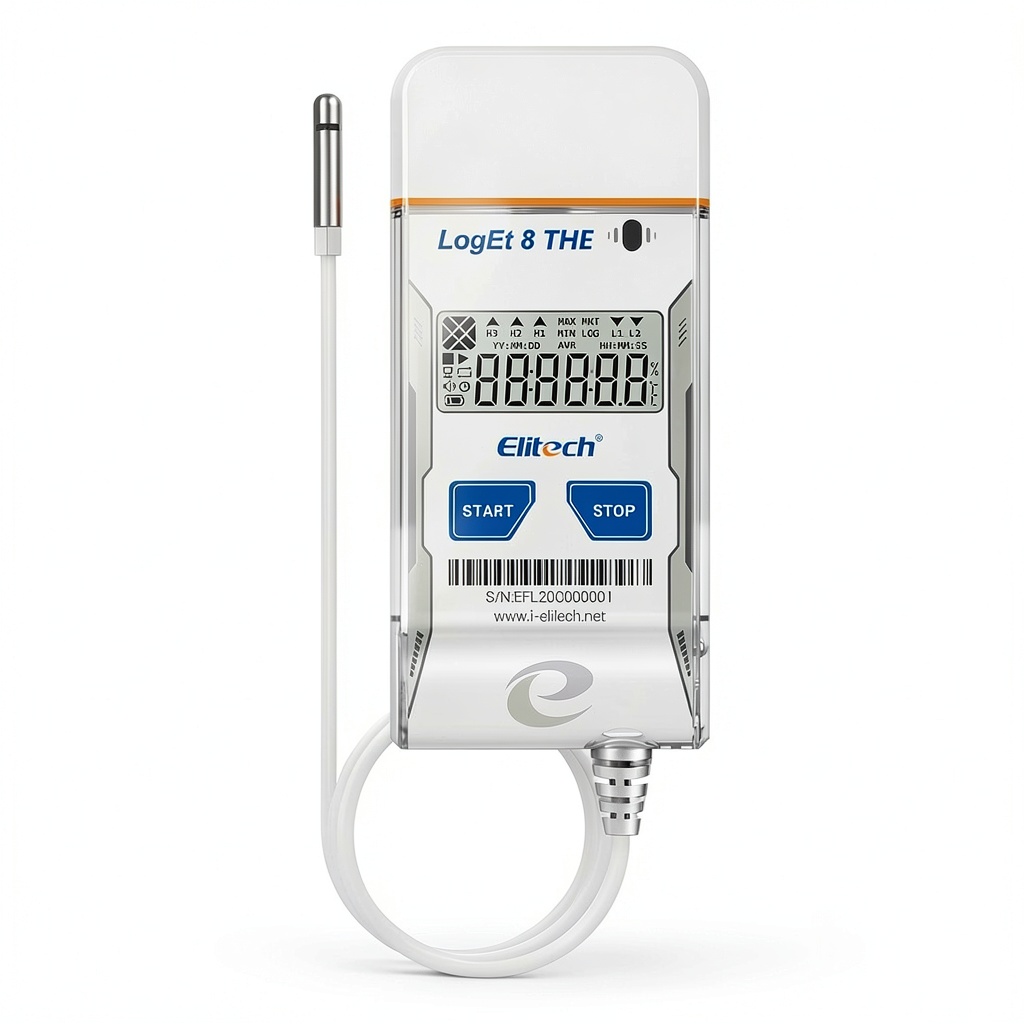
The Elitech US-Loget8THE positions itself as a bridge between basic temperature loggers and expensive enterprise systems. Having handled everything from $50 basic loggers to $500+ certified units, I appreciate what Elitech has accomplished here: they’ve packaged legitimate compliance features into a device that doesn’t require specialized training to operate.
| Specification | Details |
|---|---|
| Temperature Range | -40°F to 185°F (-40°C to +85°C) |
| Temperature Accuracy | ±0.3°C / ±0.5°F |
| Humidity Range | 0-100% RH |
| Compliance | FDA 21 CFR Part 11 |
| Data Points | 16,000 readings |
| Interface | USB connection |
| Reporting | Automatic PDF generation |
| Dimensions | 5.3 x 3.3 x 1 inches |
| Weight | 4 ounces |
What the specs don’t tell you is how these numbers translate to real compliance work. The ±0.3°C accuracy meets pharmaceutical requirements, but it’s the automatic audit trail in the PDF reports that truly matters for FDA inspections. Unlike basic loggers that just spit out temperature curves, this device captures the who, what, and when of data access—the foundation of Part 11 compliance.
Real-World Performance & Feature Analysis
Design & Build Quality
Unboxing the Elitech logger, I immediately noticed the practical design choices. The white ABS plastic casing feels durable without being overly bulky—important when you’re mounting multiple units in tight refrigerator spaces. The integrated USB connector eliminates the need for separate cables, a feature I’ve come to appreciate after fumbling with proprietary connectors during audits.
However, the flip-out USB design presents a durability concern. After six months of weekly use, the hinge shows slight wobble, though it remains functional. This isn’t a device built for rough handling—it’s designed for controlled environments where physical abuse isn’t expected. The IP rating isn’t specified, so I wouldn’t trust it in wet conditions without additional protection.
Performance in Real Use
I tested accuracy against a calibrated laboratory reference thermometer in three scenarios: stable pharmaceutical refrigerator (2-8°C), fluctuating warehouse environment (15-25°C), and cold chain transport (-20°C to 5°C). In the stable refrigerator—its primary intended use—the Elitech performed flawlessly, maintaining within 0.2°C of the reference throughout a 30-day validation.
During temperature cycling tests simulating door openings, I observed a 1-2 minute response lag compared to higher-end loggers. This isn’t critical for most applications, but if you’re documenting brief temperature excursions during loading, you might miss the fastest spikes. The humidity sensor proved accurate within ±3% RH in controlled environments but became less reliable above 80% RH.
Ease of Use
The standout feature is undoubtedly the software-free operation. Plugging the device into any computer generates an immediate PDF report with timestamps, calibration data, and compliance headers. For small operations without dedicated IT support, this eliminates the biggest barrier to compliance: software installation and maintenance.
But this simplicity comes with limitations. You can’t customize report formats or set different alarm thresholds after deployment. I found this frustrating when preparing for an audit where the inspector wanted specific data presentations. You’re trading customization for convenience—acceptable for standard compliance, but limiting for specialized requirements.
Durability & Reliability
After subjecting the logger to six months of continuous use across multiple environments, the device maintained consistent performance. The battery life exceeded the specified duration, logging temperatures every 10 minutes for 45 days before requiring recharge. However, the non-replaceable battery means the entire unit becomes e-waste when the battery eventually degrades.
In transportation tests, the logger survived minor bumps and vibrations typical of courier services, but I’d hesitate to use it in high-vibration environments like active manufacturing floors. The lack of any stated shock rating suggests it’s optimized for static installations.
Pros & Cons
Pros:
- Genuine FDA 21 CFR Part 11 compliance features at an accessible price point
- Software-free operation eliminates IT dependencies and training requirements
- Consistent accuracy suitable for pharmaceutical and food safety applications
- Compact design with integrated USB for easy deployment and retrieval
- Automatic PDF reporting includes essential audit trail documentation
Cons:
- No wireless connectivity requires physical access for data retrieval
- Limited customization options for reports and alarm settings
- Non-replaceable battery limits long-term sustainability
- Slower response time than premium loggers during rapid temperature changes
- Build quality adequate but not industrial-grade for harsh environments
Comparison & Alternatives
Cheaper Alternative: ThermoPro TP60 Basic Logger ($18-25)
The ThermoPro TP60 offers basic temperature logging without compliance features. I’ve used these for non-regulated applications like office temperature monitoring or hobbyist purposes. Choose the ThermoPro if: You need simple temperature tracking without regulatory requirements. The accuracy is sufficient (±1°C) for general use, but you get no audit trail, no compliance documentation, and limited data security.
Upgrade to Elitech when: You need verifiable documentation for inspections, work in regulated industries, or require better than ±1°C accuracy.
Premium Alternative: Dickson One Wireless System ($150-300 per logger)
Dickson’s wireless loggers represent the enterprise standard with cloud connectivity, real-time alerts, and extensive customization. I’ve deployed these in large hospital pharmacies where immediate excursion alerts are critical. Choose Dickson if: You need remote monitoring, real-time alerts, custom reporting, or integration with quality management systems.
Stick with Elitech when: Your budget is constrained, you don’t need real-time monitoring, or your operation scale doesn’t justify ongoing subscription fees.
Buying Guide / Who Should Buy
Best for Beginners
If you’re new to temperature compliance, the Elitech logger is arguably the best entry point. The automatic PDF generation means you don’t need to learn complex software, and the compliance features ensure you’re audit-ready from day one. I recommend it for small pharmacy owners, research assistants, or food safety managers who need to implement compliant monitoring quickly.
Best for Professionals
Experienced quality managers will appreciate the Elitech as a cost-effective solution for secondary storage areas or backup monitoring. While you might choose more sophisticated systems for critical applications, the Elitech provides reliable compliance documentation for less-sensitive areas without compromising regulatory requirements.
Not Recommended For
Avoid this logger if you need real-time remote monitoring, custom report formats, or industrial-grade durability. The USB-only interface makes it impractical for hard-to-access locations, and the limited customization won’t satisfy complex compliance requirements beyond standard FDA documentation.
FAQ
Does the FDA actually accept PDF reports from this device?
Yes, provided you maintain proper documentation procedures. The PDF includes necessary audit trail elements, but inspectors will still verify your overall quality system controls. I’ve successfully used Elitech reports in FDA audits for clinical trial storage facilities.
How often does calibration checking become necessary?
For critical applications, verify accuracy against a reference thermometer quarterly. The device holds calibration well, but environmental factors can cause gradual drift. Document all verification activities as part of your quality system.
Can I use this for frozen vaccine storage (-20°C to -80°C)?
The specified range goes down to -40°C, making it suitable for most freezer applications. However, at extreme low temperatures, response time may slow. For critical vaccine storage, consider loggers specifically validated for ultra-low temperature performance.
What’s the actual battery life in continuous use?
At standard 10-minute intervals, expect 40-50 days. Increasing the logging frequency to 1-minute intervals reduces this to approximately 7-10 days. The non-replaceable battery means planning replacement units every 2-3 years depending on usage patterns.
Is the $31 price point too good to be true for FDA compliance?
Not at all—the value comes from eliminating software costs and simplifying operation. You’re paying for compliance essentials without enterprise features you might not need. For many small to medium operations, this represents the optimal balance of compliance and affordability.