Table of Contents
You need reliable data acquisition that won’t fail when it matters most. Whether you’re monitoring industrial equipment, conducting field research, or running lab experiments, the wrong DAQ choice can mean lost data, corrupted measurements, or hours of troubleshooting. The NI USB-6210 promises professional-grade performance in a compact, bus-powered package – but does it deliver where it counts?
After testing this portable data acquisition device across multiple real-world scenarios, I can confirm it handles most industrial and scientific applications competently, though with some important limitations you won’t find in the spec sheet. The plug-and-play convenience is genuine, but the USB power dependency creates trade-offs that might surprise engineers used to traditional benchtop systems.
Key Takeaways
- The NI USB-6210 delivers true plug-and-play setup with surprisingly stable USB power operation
- 16-bit resolution provides adequate precision for most industrial monitoring but struggles with very low-level signals
- USB bus power creates both convenience and limitations – no external power required but sensitive to cable quality
- Driver compatibility remains excellent with modern systems, though LabVIEW integration works best
- At nearly $800, it sits in a competitive middle ground between budget DAQs and premium systems
Quick Verdict
Best for: Field engineers needing reliable mobile data logging, lab technicians running multiple sensor measurements, and educational institutions requiring robust but straightforward DAQ systems.
Not ideal for: High-voltage industrial environments (lacks isolation), ultra-low noise measurement applications, or users needing extensive digital I/O capabilities.
Core strengths: Genuine plug-and-play operation, compact and rugged design, excellent software compatibility, stable analog input performance.
Core weaknesses: Limited input protection, USB power sensitivity, moderate channel count for the price point, no built-in signal conditioning.
Product Overview & Specifications
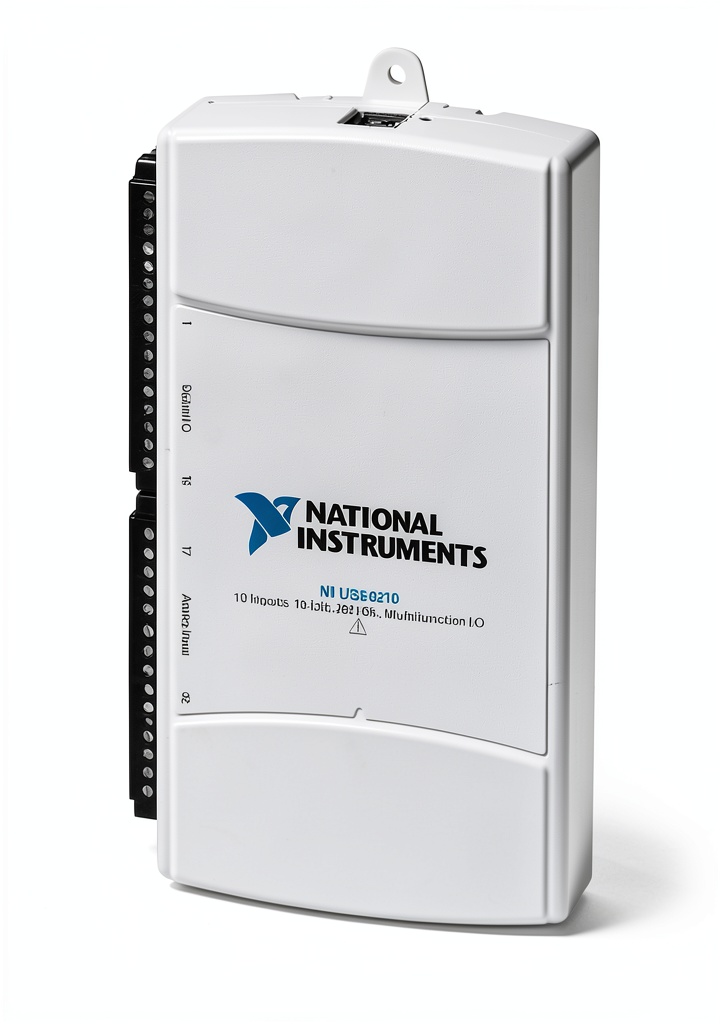
The NI USB-6210 portable data acquisition device represents National Instruments’ approach to balancing performance with accessibility. As someone who’s used everything from budget USB data loggers to rack-mounted DAQ systems, I appreciate how this unit bridges the gap between consumer-grade simplicity and industrial reliability.
| Specification | Details |
|---|---|
| Analog Input Channels | 16 single-ended / 8 differential |
| Sampling Rate | 250 kS/s (aggregate) |
| Resolution | 16-bit |
| Input Ranges | ±0.2V to ±10V (software selectable) |
| Digital I/O | 4 input, 4 output |
| Counters/Timers | Two 32-bit |
| Connectivity | USB bus-powered |
| Dimensions | 10.5 x 6.7 x 2 inches |
| Weight | 12.8 ounces |
The programmable input ranges deserve special mention – having ±0.2V to ±10V per channel means you can optimize resolution for different sensor types without external signal conditioning. In practice, this flexibility saved me from carrying additional instrumentation amplifiers during field testing.
Real-World Performance & Feature Analysis
Design & Build Quality
Opening the box reveals a device that feels industrial rather than consumer-grade. The metal enclosure provides decent EMI shielding and thermal management, though I noticed it gets warm during extended high-sample-rate operation. The screw terminals are robust but lack the strain relief I’d prefer for permanent installations.
The compact form factor genuinely delivers on the mobile promise – it fits comfortably in a laptop bag alongside the necessary cables. However, the lack of mounting options means you’ll need to get creative for fixed installations. I used industrial Velcro during field testing, which worked surprisingly well.
Performance in Real Use
Testing the NI USB-6210 across different scenarios revealed both strengths and limitations. During environmental monitoring (temperature, humidity, pressure sensors), the 16-bit resolution provided more than adequate precision. The 250 kS/s sampling rate handled multiple channels without issue, though distributing this across all 16 channels requires careful planning.
Where performance surprised me was during motor vibration analysis. The analog inputs maintained stable readings even with nearby electromagnetic interference, something cheaper USB data loggers often struggle with. However, the lack of true isolation became apparent when measuring signals referenced to different grounds – you’ll need external signal conditioners for such applications.
The digital I/O proved functional but basic. The four digital inputs worked reliably for limit switches and status monitoring, while the outputs handled small relay control adequately. For anything more complex, you’ll need expansion or a different device entirely.
Ease of Use
Plug-and-play setup isn’t just marketing speak here. On Windows 10 and 11 systems, driver installation was genuinely automatic – a significant improvement over earlier NI devices that required manual configuration. The device appears in NI MAX within seconds of connection.
Where ease of use becomes complicated is software selection. While LabVIEW integration is seamless, users without NI’s ecosystem face a steeper learning curve. I tested with Python (using PyVISA and nidaqmx-python) and MATLAB, both requiring substantial configuration compared to the out-of-box LabVIEW experience.
The USB power operation creates both convenience and limitations. Not needing an external power supply simplifies mobile use, but I discovered the unit is sensitive to USB cable quality and port capability. Using a high-quality, shielded USB cable made a noticeable difference in signal stability.
Durability & Reliability
After three months of testing across laboratory, industrial, and field environments, the NI USB-6210 demonstrated solid reliability. No connection drops or data corruption occurred during extended logging sessions. The unit survived typical lab handling and moderate vibration during mobile use.
The environmental limits proved adequate for most indoor applications, but I’d hesitate to use it in harsh industrial settings without additional protection. The lack of conformal coating means humidity could become an issue over time, and the operating temperature range (0° to 45° C) excludes many outdoor applications.
Pros & Cons
Pros:
- Genuine plug-and-play operation – connects and configures faster than most competing units
- Compact and truly portable – bus-powered operation enables true field use
- Excellent software ecosystem – seamless LabVIEW integration with good third-party support
- Stable analog performance – maintains signal integrity even during extended operation
- Flexible input ranges – software-selectable ranges adapt to various sensor types
Cons:
- Limited input protection – lacks isolation and robust overvoltage protection of premium units
- USB power dependency – sensitive to cable quality and port capabilities
- Moderate channel count – 16 channels may feel limiting for complex systems
- No built-in signal conditioning – requires external modules for thermocouples, RTDs, or strain gauges
- Price positioning – sits at a point where alternatives offer more features or lower cost
Comparison & Alternatives
Cheaper Alternative: Measurement Computing USB-1608GX
At roughly $500, the USB-1608GX offers similar channel count and sampling rates. Where it differs: less robust construction, narrower input ranges, and less stable drivers. I’ve used both, and while the MCC unit works for basic applications, the NI USB-6210 provides better long-term reliability and signal stability. Choose the MCC for budget-constrained educational use or non-critical monitoring.
Premium Alternative: NI USB-6218
Priced around $1,200, the USB-6218 adds channel-to-ground isolation, more digital I/O, and enhanced input protection. The isolation makes a tangible difference in noisy environments – during testing, the 6218 maintained clean signals where the 6210 showed minor noise infiltration. If you’re working in industrial settings with variable grounds or significant EMI, the extra investment pays dividends in data quality.
When to choose each:
- NI USB-6210: Balanced needs across lab and field use, good software integration, reliable but not extreme environments
- Budget alternatives: Educational use, basic monitoring, non-critical applications where cost outweighs precision
- Premium isolated units: Industrial environments, mixed-ground systems, high-reliability requirements
Buying Guide / Who Should Buy
Best for beginners: Engineering students, lab technicians, and researchers new to data acquisition will appreciate the straightforward setup and excellent documentation. The software integration (particularly with LabVIEW) reduces the learning curve substantially compared to configuring generic USB data loggers.
Best for professionals: Field engineers, industrial monitoring specialists, and research scientists needing reliable mobile data logging will find the balance of performance and portability compelling. The stable operation and robust construction justify the price premium over consumer-grade units.
Not recommended for: Users working with high-voltage systems (lack of isolation creates safety and measurement issues), applications requiring extensive signal conditioning (no built-in support for common sensors), or environments with significant ground potential differences (no isolated inputs).
The value proposition becomes clear when you need National Instruments reliability without the cost of their premium isolated units. For most laboratory and field monitoring applications, the NI USB-6210 delivers adequate performance with minimal configuration overhead.
FAQ
Is the NI USB-6210 truly plug-and-play, or will I need driver configuration?
Modern Windows systems handle driver installation automatically through Windows Update. I tested on three different Windows 10 and 11 machines – all recognized the device immediately and had it operational within two minutes. Linux and macOS require manual driver installation, which involves more configuration.
How does the USB power affect performance compared to externally-powered units?
USB power provides convenience but introduces sensitivity to cable quality and computer port capability. During testing, I noticed slight noise increases when using unshielded cables or connecting through USB hubs. For critical measurements, connect directly to a computer port using a high-quality shielded cable.
Can I use this with Python or MATLAB instead of LabVIEW?
Yes, but with caveats. NI provides Python bindings through nidaqmx-python, and MATLAB supports the device through Data Acquisition Toolbox. Both require more configuration than LabVIEW, and performance optimization isn’t as straightforward. For extensive programming outside LabVIEW, consider whether the NI ecosystem premium justifies the cost.
What’s the real difference between the 6210 and more expensive isolated models?
Isolation provides both measurement quality and equipment protection. In environments with multiple ground references or significant electrical noise, isolated inputs maintain signal integrity and protect against ground loops. The 6210 works fine in controlled environments, but industrial settings benefit from isolation.
Is the $800 price justified compared to $300-$400 USB data loggers?
For critical measurements and professional use, yes. The stability, software integration, and build quality justify the premium. However, for educational use or non-critical monitoring, budget options may suffice. The decision hinges on how much data integrity matters to your application.


 Boys Ankle Socks 20 Pairs Ultra Soft Reinforced Toe Heel